October Light by John Gardner
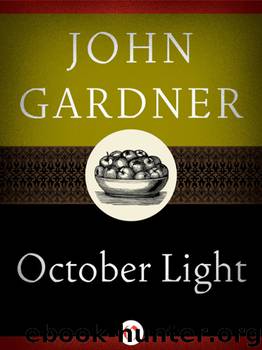
Author:John Gardner
Language: eng
Format: epub, azw3
Tags: ebook
Publisher: Open Road Integrated Media
Published: 2010-08-06T04:00:00+00:00
But for no real reason he loved the fool thing
And kept the thing functioning age after age.
The dinosaurs died out, or began to sing,
Transformed into birds; apes became the rage;
But the ’Possum trudged on—with some other antiques:
Spiders, sand-crabs, various old freaks.
“Father,” said the Son, “that Opossum’s a killer—
Murders baby chicks for no reason. He’s got to go!
Times have changed, and changed for the better.
He’s an anachronism, if I may say so.”
God sighed. “Peace and Justice are right,” he said,
And whispered to the ’Possum, “Lie down. Play dead.”
The company all laughed, as they always did when Ruth Thomas recited poetry. And as always, they wouldn’t let her off with just one. She was an artist of a sort almost vanished from the earth—the “country reciter,” as William Lyon Phelps, Estelle Parks’ teacher, had called it in his book. “The verse equivalent of the folk-singer.” They got their poems from everywhere, these country reciters—from calendars, feed-store account books and almanacs, small-town newspapers, verse-writing aunts, occasionally old school-books or the Saturday Evening Post. No doubt now and then a reciter wrote some of his verses himself, but there was, in the heyday of the country reciter, no great honor in that, and he tended to make not too much of it. Certain poems were, for all reciters, classic, of course, written by known poets like Eugene Field and Henry Wadsworth Longfellow, names “now universally scorned by the literate,” as Professor Phelps said, “though one might hesitate to scorn them after hearing them presented by a reciter.”
Ruth Thomas, at least in Estelle’s opinion, was as good a reciter as any to be found in these degenerate days, though not pure in technique. The faces she made—bugged eyes, pursed lips—and her tendency to insist on the different voices when a poem used dialogue—all these showed she’d been just a touch corrupted by dramatic monologue and the Broadway stage. Be that as it may, she was the best you could hope for, and the effect on the company was not much worse than in former times, “the true and proper effect of all art,” Professor Phelps had written, “when it is taken for granted, when no fine distinctions between bad and good are thought necessary, so that the more-or-less good has a way of prevailing, unthreatened by the overreaching snatch at ‘the Great’ which creates failed masterworks and devalues the merely excellent, leaving all the world rubble and a babble of mixed-up languages.” It was a passage Estelle had often quoted to students and had even used once at a School Board meeting, in defense of she forgot just what. Even now, after all these years, it was impossible for Estelle to hear Ruth recite without thinking of William Lyon Phelps. She was glad of that, perhaps even forced the recollection a little. It heightened her pleasure in listening.
“Say another one,” Virginia said. “Say the one about the cat and dog.”
“That’s a good one,” Ruth’s grandson DeWitt said, then blushed.
“The Cat and the Dog,” Ruth Thomas began.
Download
This site does not store any files on its server. We only index and link to content provided by other sites. Please contact the content providers to delete copyright contents if any and email us, we'll remove relevant links or contents immediately.
Red by Erica Spindler(12546)
Crooked Kingdom: Book 2 (Six of Crows) by Bardugo Leigh(12291)
Twisted Palace by Erin Watt(11131)
Mindhunter: Inside the FBI's Elite Serial Crime Unit by John E. Douglas & Mark Olshaker(9297)
Fangirl by Rainbow Rowell(9211)
Never let me go by Kazuo Ishiguro(8847)
All the Light We Cannot See: A Novel by Anthony Doerr(8474)
A Man Called Ove: A Novel by Fredrik Backman(8414)
The Lover by Duras Marguerite(7875)
Confessions of an Ugly Stepsister by Gregory Maguire(7862)
Little Fires Everywhere by Celeste Ng(7170)
The Vegetarian by Han Kang(6273)
To All the Boys I've Loved Before by Jenny Han(5829)
The Shadow Of The Wind by Carlos Ruiz Zafón(5676)
On the Yard (New York Review Books Classics) by Braly Malcolm(5519)
Keepsake: True North #2 by Sarina Bowen(5405)
Dancing After Hours by Andre Dubus(5268)
Ken Follett - World without end by Ken Follett(4705)
The Perks of Being a Wallflower by Stephen Chbosky(4626)
